San Francisco on a Budget: Free Things to Do, Cheap Eats & Money-Saving Secrets
Discover how to visit San Francisco on a budget: the best free attractions, cheap eats in the Mission, transit tips & when to visit to pay less.
San Francisco on a Budget: Free Things to Do, Cheap Eats & Money-Saving Secrets
San Francisco has one of the most intimidating reputations in American travel. The $8 toast jokes, the $4,000 studio apartments, the tech-worker salaries that have reshaped the city — none of it exactly screams "budget getaway." But here's what most visitors discover quickly: the soul of San Francisco is almost entirely free.
The Golden Gate Bridge doesn't charge an entry fee. Neither does Dolores Park, Baker Beach, Lands End Trail, or the 1,017 acres of Golden Gate Park. The Mission District murals on Clarion and Balmy Alley are on public streets, open to anyone. The sea lions at Pier 39 have been freeloading since 1990 and haven't started charging yet.
With the right approach, a realistic daily budget in San Francisco is $100–$140 per person — covering accommodation, food, transport, and one or two paid attractions. This guide shows you exactly how to get there, without missing a single thing worth seeing.
What Does It Really Cost to Visit San Francisco?
A realistic budget for San Francisco is $100–$140 per person per day, assuming hostel or budget accommodation, eating at local spots in the Mission and Chinatown, using Muni for transport, and prioritizing the city's extensive free attractions.
Here's a rough breakdown:
| Category | Budget Option | Cost/Day |
|---|---|---|
| Accommodation | Hostel dorm | $45–$75 |
| Food | Local restaurants, no tourist traps | $25–$40 |
| Transport | Muni day pass | $5 |
| Attractions | Mix of free + 1 paid | $0–$45 |
| Total | $75–$165 |
The biggest lever is accommodation — stay in a hostel or cross the Bay to Oakland, and your daily cost drops significantly. For a broader look at everything the city offers, check out our complete guide to things to do in San Francisco.
Free Outdoor Attractions: SF's Greatest Assets
The outdoors is where San Francisco wins decisively, and it costs absolutely nothing.
Golden Gate Park
At over 1,000 acres — larger than Central Park — Golden Gate Park is San Francisco's great free playground. Trails wind through meadows, past a real bison paddock, into Japanese-inspired gardens and out to Ocean Beach. The Dutch Windmills, Stow Lake shores, the polo fields, and the Panhandle green space are all free. On most Sundays, impromptu drum circles fill Hippie Hill. Small fees apply at the Japanese Tea Garden ($9) and the Conservatory of Flowers ($9), but the park itself is open and free to all.
Walk (or Bike) the Golden Gate Bridge
Walking or cycling across the 1.7-mile span of the Golden Gate Bridge is free and one of the most iconic experiences in the United States. You pass over the Bay, through the towers, with unobstructed views of Marin, Alcatraz, and the city skyline behind you. Walking one way takes about 30 minutes; biking across and back takes around 45. Bike rentals near Fisherman's Wharf or Haight-Ashbury typically run $35–$50/day. The 28 bus from downtown drops you close to the south entrance.
Dolores Park
The Mission District's unofficial living room, Dolores Park on a sunny afternoon is pure San Francisco: picnickers, food cart vendors, off-leash dogs, and a downtown skyline view that makes paying for an observation deck feel unnecessary. Free, always open, and most magical on weekday afternoons when the crowds thin.
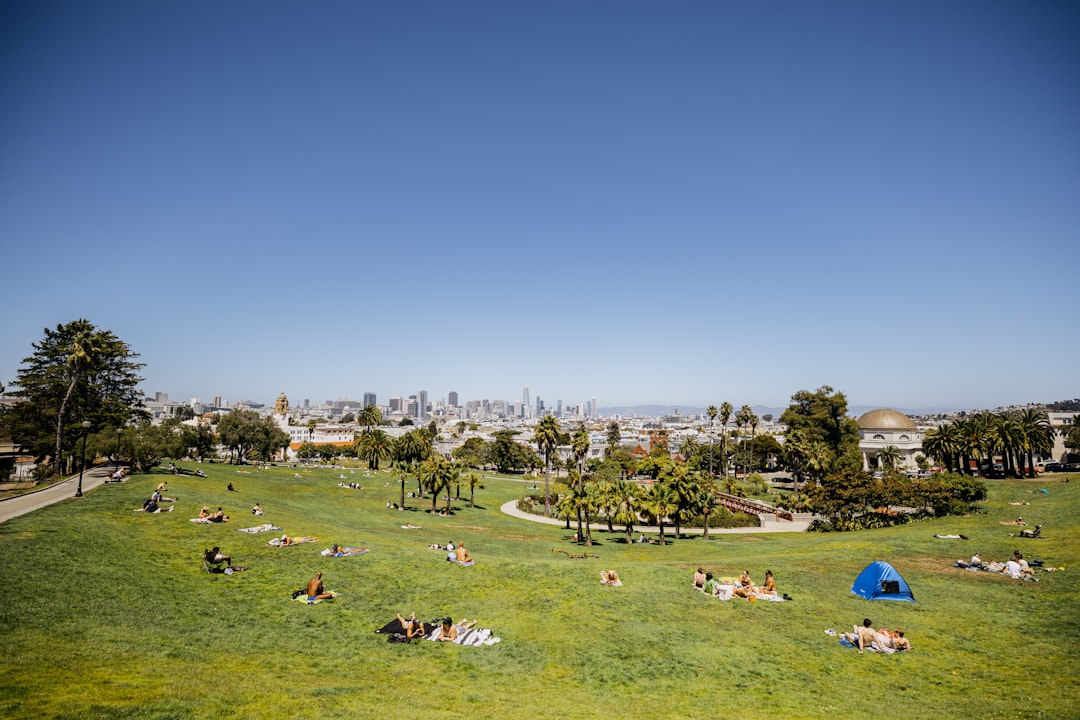 Photo by Alex Reynolds on Unsplash
Lands End Trail & the Sutro Baths Ruins
Arguably the best free urban hike in America. The Lands End Trail runs 3.5 miles along coastal bluffs through wind-bent cypress forest, with views of the Marin Headlands, the open Pacific, and the ruins of the Sutro Baths — a Victorian-era public swimming complex destroyed by fire in 1966. The skeletal concrete ruins at the water's edge are genuinely haunting. Trailhead accessible via the 38 Geary or 5 Fulton bus line.
Baker Beach
Hidden beneath the Presidio, Baker Beach offers a ground-level view of the Golden Gate Bridge that no other spot in the city replicates. Arrive by 9am for free street parking; otherwise, the 29 Sunset bus stops within walking distance.
Twin Peaks
A short hike or drive to Twin Peaks (elevation 922 feet) gives you a full 360-degree panorama of the Bay Area: the Bay Bridge, the East Bay hills, Mount Tamalpais, and on clear days, the Farallon Islands 27 miles offshore. No entry fee, no queue. The Muni 37 bus climbs partway; the summit walk takes under 10 minutes from the bus stop.
Mission District Murals
The Mission District's outdoor art corridor — Clarion Alley and Balmy Alley — is one of the densest concentrations of public murals in the world. Hundreds of works, constantly refreshed, covering immigration, queer history, Mexican folk tradition, and political commentary. Walk both alleys in a single afternoon for free, then explore the neighborhood's taquerias and bakeries while you're there.
Pier 39 Sea Lions
Since establishing their colony at K-Dock in January 1990, the California sea lions have become one of San Francisco's most beloved sights — and admission is zero. Up to 1,500 animals haul out here during winter; summer sees fewer but there are always some present. The Marine Mammal Center hosts free weekend educational programs nearby.
Free & Cheap Museums
Cable Car Museum — Always Free
The Cable Car Museum on Mason Street is free, always. You can watch the actual underground cable machinery that powers all three cable car lines from a mezzanine above the winding room — these are the live cables pulling real cars up the city's hills in real time. A surprisingly compelling 45 minutes that most tourists walk straight past.
Musée Mécanique — Free Entry
Tucked inside Pier 45 at Fisherman's Wharf, the Musée Mécanique houses one of the world's largest private collections of antique coin-operated mechanical amusements: fortune tellers, player pianos, vintage arcade games, hand-cranked peep shows, and seaside carnival machines dating from the 1800s through the 1980s. Entry is free. Games cost quarters and dimes. Budget an hour and $5 in coins.
de Young Museum
The de Young's permanent collection — American art from the 17th century to the present, international textiles, and the free observation tower — is worth the $20 admission on its own. The museum offers free admission periodically (check their website for current free days). The outdoor sculpture garden in the Music Concourse is always free.
SFMOMA
San Francisco's Museum of Modern Art holds a world-class permanent collection: Rothko, Bourgeois, Calder, Warhol, and one of the finest photography departments in the country. Visitors under 18 are always free. Check the SFMOMA website for current free evening hours (historically Thursday evenings, though schedules can change seasonally).
California Academy of Sciences
No consistent free days, but discounts are available for San Francisco residents, AAA members, and through discount platforms like Goldstar. The Academy's naturalist-led weekend walks into Golden Gate Park depart from the building and are free.
Cheap Eats: Where San Franciscans Actually Go
Tourist pricing and local pricing in San Francisco are parallel universes. Here's how to eat in the right one.
Mission District Burritos: $10–$13
The Mission super burrito is one of the great cheap meals in American food culture: a foil-wrapped cylinder the size of a small child, loaded with rice, beans, your protein, house-made salsa, and guacamole. El Farolito (open until 3am on weekends) and La Taqueria (James Beard Award winner) are the two canonical addresses, both on Mission Street. Budget $10–$13 for a burrito that covers a full meal. Tacos run $4–$6. Pupusas at Salvadoran spots along 24th Street are $3–$4.
Chinatown: Dim Sum and Bakeries from $2
San Francisco's Chinatown — the oldest in North America, established in 1848 — feeds its residents on working-class budgets. Good Mong Kok Bakery on Stockton Street is famous for pork buns at $1.50–$2 each. Dim sum at small lunch counters runs $3–$6 per plate. BBQ roast duck and pork hang in windows throughout the neighborhood at around $14 for a half-portion.
Fisherman's Wharf: Clam Chowder in a Sourdough Bowl
A San Francisco cliché that earns its reputation: a bowl of clam chowder in a scooped-out sourdough loaf from Boudin Bakery or any of the waterfront stands runs $12–$16. It's a full meal, you're eating at the water's edge, and you'll understand why it became iconic.
North Beach: Pizza by the Slice
San Francisco's Italian neighborhood has been serving New York–style slices for decades. A slice and a soda runs $5–$8 at spots along Columbus Avenue — a satisfying lunch for under $10, eaten standing up with excellent people-watching.
The Outer Richmond & Sunset: Ramen, Pho & Bánh Mì
The western neighborhoods — Inner and Outer Richmond along Clement Street ("the other Chinatown"), Outer Sunset along Irving Street — are where San Francisco's Vietnamese, Chinese, and Korean communities eat, at prices that reflect neighborhood restaurants rather than tourist destinations. Pho: $14–$17. Bánh mì: $6–$10. Ramen: $16–$18. These are the city's best-value meals, and the food quality rivals anything downtown.
Ferry Building Farmers' Market
Tuesday, Thursday, and Saturday mornings, local producers and prepared food vendors set up outside the Ferry Building. A $12–$15 wander gets you a complete meal: tamales, cheese samples, seasonal fruit, fresh-pressed juice, and oysters from the local vendor who opens shells at the water's edge.
 Photo by Spencer DeMera on Unsplash
Getting Around Without Spending a Fortune
The most affordable way to get around San Francisco is walking for short distances and Muni for longer ones.
San Francisco's visitor neighborhoods are compact and walkable. The Ferry Building to Fisherman's Wharf is 1.5 miles along the waterfront. Union Square to the Mission is under 2 miles. The hills are real — but they're also the reason the views are so good.
Muni (Municipal Railway): A single ride costs $2.50. A one-day Muni pass is $5 and covers unlimited rides on buses, metro, and the historic F-line streetcar. A three-day pass runs $17. Use the SFMTA Muni app or Clipper Card to load passes without cash surcharges.
BART (Bay Area Rapid Transit): The most efficient route from SFO airport to downtown costs $10–$12, compared to $50–$75 for a rideshare. A genuine no-brainer. Within the city, BART serves the Mission District (16th Street and 24th Street stations) and the Embarcadero.
The F Market Streetcar: The F-line runs the entire waterfront from Castro to Fisherman's Wharf on vintage trams from cities around the world — Milan, Blackpool, New Orleans, Kansas City. It costs the same as any Muni ride ($2.50) and is a tourist attraction in itself.
The Ferry to Sausalito: At ~$14.50 each way, the Golden Gate Ferry to Sausalito is simultaneously transport and sightseeing. The views of Alcatraz, the Bay Bridge, and the city skyline from the water are among the best in the Bay Area.
Rideshares: Reserve for late nights or specific cases where no transit runs. Surge pricing during rush hours (7–9am, 4–7pm) can push a $20 trip to $50+. Always check the Muni app first.
Cable Cars as Transport: At $9 per ride, the Powell-Hyde and Powell-Mason cable cars are priced for tourists, not commuters. Beautiful, historic, and worth doing once — but don't rely on them for daily movement.
Where to Stay on a Budget
Hostels: San Francisco has several well-established options:
- USA Hostels San Francisco (SOMA): Dorm beds $45–$70/night, free breakfast included.
- Green Tortoise Hostel (North Beach): Popular and frequently full. Free dinner several nights a week. Book well ahead. Dorm beds from $50–$80.
- HI San Francisco Fisherman's Wharf: Dorm beds $50–$85, private rooms available.
Oakland or Berkeley as base: Staying across the Bay cuts accommodation costs by 30–50%, and BART connects downtown Oakland to downtown San Francisco in about 20 minutes. Oakland's Temescal, Uptown, and Grand Lake neighborhoods are genuinely worth a half-day of their own.
Best times for lower hotel rates:
- January–February: Prices drop 25–40% below summer peak. Chinese New Year celebrations (late January or early February) provide free street festivals and firecracker parades in Chinatown.
- November post-Thanksgiving: A brief lull before holiday pricing.
- Weekday pricing: San Francisco sees significant business travel demand on weekdays in spring and fall. Hotels can sometimes be cheaper on weekends, which is the opposite of most leisure-focused cities.
Insider Money-Saving Tips
Stern Grove Festival: Every summer (June through August), the Stern Grove Festival hosts free outdoor concerts in a natural eucalyptus-ringed amphitheater in the West Portal neighborhood. National touring acts, jazz ensembles, opera performances — all free. Check sterngrove.org for the current lineup and arrive early.
Mission Happy Hours: Many Mission District and Outer Sunset bars serve happy hour drinks from $4–$6, 4–7pm. This is when residents drink out, and the vibe is neighborhood rather than tourist strip.
Book Alcatraz Early: The Alcatraz daytime audio tour is approximately $45/adult (2026 pricing); the evening tour runs $55+. It's worth doing once — the self-guided audio tour narrated by former guards and inmates is genuinely excellent. Book 2–4 weeks ahead online. Summer dates, particularly July and August, sell out completely and there is essentially no walk-up availability.
San Francisco CityPASS Math: The CityPASS ($82/adult) includes the California Academy of Sciences, the de Young, the Aquarium of the Bay, and a Muni/Cable Car passport. Run the numbers against your actual itinerary. It pays off clearly if you'd visit all four; less so if you'd skip two of them.
Free Event Calendar: SF Recreation & Parks runs free programming in parks throughout the year. Off the Grid, the rotating food truck market at Fort Mason and other sites, is free to enter. Check the SF Events calendar (sfrecpark.org) before your trip.
When to Visit San Francisco to Save the Most
September and October are the city's best-kept seasonal secret. The summer fog that blankets neighborhoods like the Sunset and Richmond from June through August typically lifts by September. Temperatures climb into the 65–75°F range, skies clear, and hotel rates fall below their summer peak. Locals refer to this stretch as their actual summer.
January and February offer the lowest prices of the year. Hotel rates drop 25–40% below summer peak, Alcatraz has available dates, and lines at popular spots are short. Chinese New Year celebrations in late January or early February — dragon parades, firecracker ceremonies, street markets in Chinatown — add genuine festivity to the off-season visit.
Avoid June, July, and August if budget is your priority. Summer is peak tourist season but paradoxically San Francisco's coldest, foggiest stretch. Karl the Fog is a real meteorological phenomenon that rolls in from the Pacific by noon most days. You'll need a jacket in July. Hotels charge their maximum, and Alcatraz sells out weeks in advance.
If San Francisco is part of a larger West Coast trip, our US road trip planning guide covers the logistics of building an efficient multi-city itinerary. And if you're applying the budget approach to other American cities, see our guide to visiting New York City on a budget for direct comparison.
FAQ
How to see San Francisco on a budget? Focus on the city's free assets: walk Lands End Trail, spend an afternoon at Dolores Park, cross the Golden Gate Bridge on foot, explore the Mission District murals on Clarion and Balmy Alley, and watch the sea lions at Pier 39. Eat in the Mission ($10–$13 burritos) and Chinatown ($2–$6 dim sum). Use a Muni day pass ($5) instead of rideshares. A full day of genuine San Francisco experiences can come in under $30 per person if built around free attractions and neighborhood restaurants.
What is the cheapest month to go to San Francisco? January and February are consistently the cheapest months, with hotel rates 25–40% below summer peak and minimal competition at popular attractions. The additional benefit: Chinese New Year celebrations in late January or early February bring free street festivals and dragon parades to Chinatown that most tourists never plan around.
What is the most affordable way to get around San Francisco? Walking covers most of the visitor-facing neighborhoods within reasonable distances. For longer trips, the Muni day pass ($5) offers unlimited rides on buses, metro, and the vintage F-line streetcar. BART is essential for airport transfers ($10–$12 vs. $50+ for rideshares). Avoid rideshares during rush hour when surge pricing can triple the base fare.
Is San Francisco worth visiting on a tight budget? Yes, genuinely. The free natural and cultural assets — the coastline, the parks, the neighborhood street life, the murals — are the authentic San Francisco experience. The expensive parts (Michelin-starred restaurants, cable car rides as daily transport, luxury hotels) are largely optional. Budget travelers who walk widely and eat where locals eat often describe getting more out of San Francisco than visitors who stayed in their hotel neighborhood and ate at Fisherman's Wharf.
What is the daily budget for San Francisco? A realistic daily budget is $100–$140 per person: hostel dorm ($45–$75), two local meals ($25–$40), a Muni day pass ($5), and a mix of free and one paid attraction. Staying in Oakland and BAR-Ting in reduces accommodation costs by $20–$40/night.
Want to build your own spot list?
Join Spotli.st and share your favorite places with the world.
Create my free account