Portland, Oregon: The Best Things to Do in the City of Roses
Discover the best things to do in Portland, Oregon — Powell's Books, Multnomah Falls, food carts, craft beer, neighborhoods & day trips. Your complete 2026 guide.
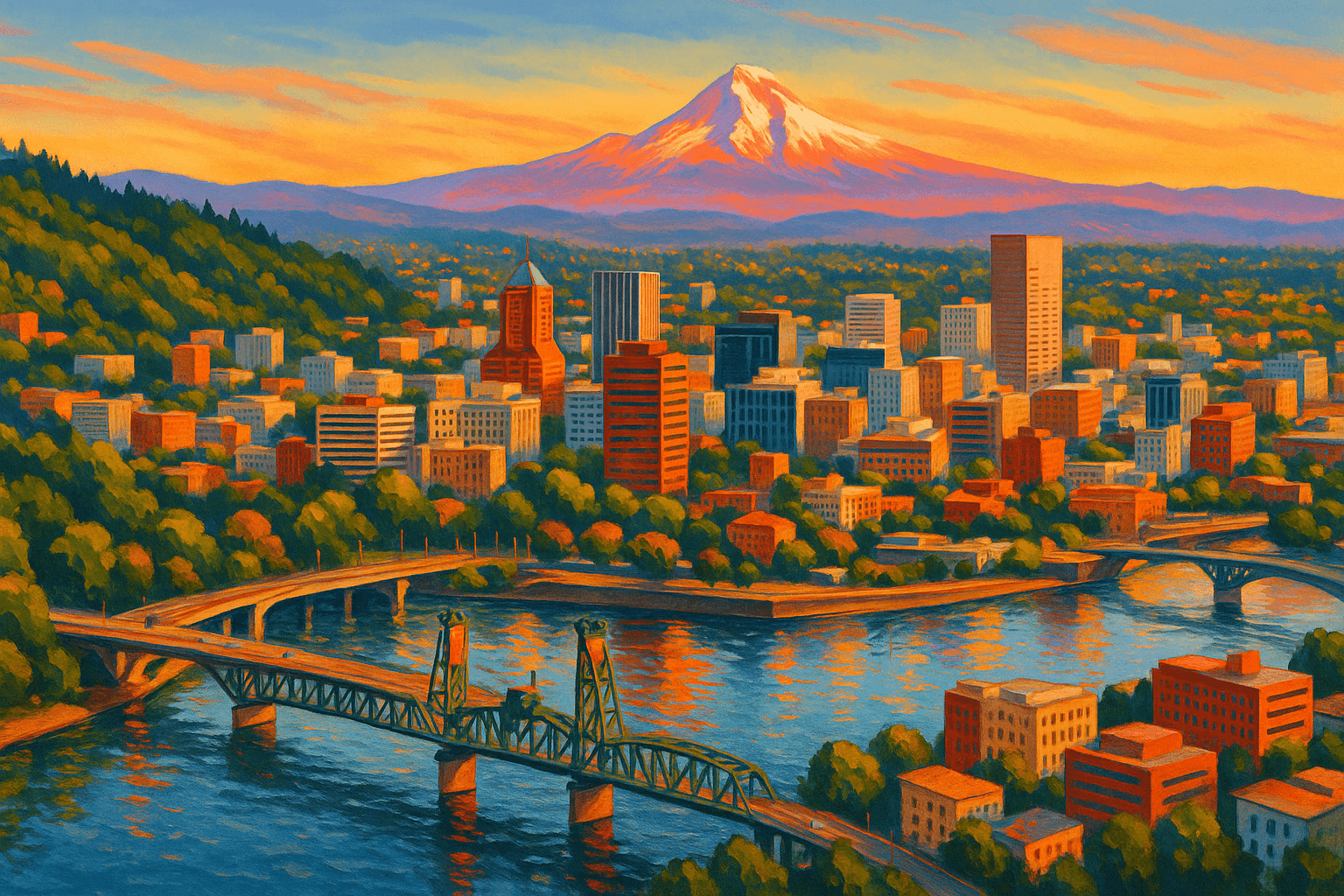

Portland, Oregon: The Best Things to Do in the City of Roses
"Keep Portland Weird" isn't just a bumper sticker — it's a civic philosophy. Portland operates at its own frequency: a city where a world-class bookstore occupies an entire city block, where food carts serving James Beard-worthy dishes cluster in open-air pods, and where you can hike through 5,000 acres of old-growth forest without leaving city limits.
Nestled at the confluence of the Willamette and Columbia rivers, with the Cascade Range rising to the east and the Pacific Ocean less than two hours west, Portland rewards travelers who lean into its contradictions: urban and wild, polished and scruffy, deeply local and genuinely welcoming. Whether you have a long weekend or a full week, here's your complete guide to the best things to do in Portland, Oregon.
What Is Portland, Oregon Famous For?
Portland is famous for Powell's City of Books (the world's largest independent bookstore), its extraordinary food cart culture, a prolific craft beer scene, Forest Park, the International Rose Test Garden, and unmatched access to natural wonders — the Columbia River Gorge, Oregon Coast, and Mount Hood are all within 90 minutes of downtown.
It's also the city that gave the world Voodoo Doughnut, the Portland Trail Blazers (and their "Rip City" battle cry), and the enduring philosophy that weird, independent, and local are always preferable to predictable.
Powell's City of Books: The World's Largest Independent Bookstore
No first visit to Portland is complete without at least an hour inside Powell's City of Books on W Burnside Street. This legendary independent bookstore occupies an entire city block across multiple floors and houses over one million new, used, and rare books.
Navigate by color-coded rooms — the Gold Room for science fiction and fantasy, the Blue Room for travel, the Pearl Room for rare and antiquarian books. The staff recommendations are genuine and frequently excellent. Budget two to three hours minimum; bibliophiles have been known to lose entire afternoons.
Tip: Pick up the store map at the entrance. It is not ironic. You will get lost without it.
Washington Park: Rose Gardens, the Oregon Zoo & a Stunning Japanese Garden
Washington Park in the West Hills is Portland's most concentrated cluster of major attractions, covering 410 acres above downtown.
International Rose Test Garden
The International Rose Test Garden is the oldest continuously operating public rose test garden in the United States, established in 1917. Over 10,000 rose plants representing more than 650 varieties bloom from late May through October, with Mount Hood visible through the petals on clear days.
Peak season: June–July for the main bloom; September for a quieter second flush. Admission is free. Arrive on a weekday morning for the best experience.
Portland Japanese Garden
Adjacent to the Rose Garden, the Portland Japanese Garden is widely regarded as one of the most authentic Japanese gardens outside Japan — a claim reinforced by the Japanese ambassador to the United States. Five distinct garden styles, including a serene Strolling Pond Garden and a meditative Sand and Stone Garden, spread across 12 acres of hillside. Admission: approximately $22 for adults.
Oregon Zoo
The Oregon Zoo, also within Washington Park, is home to more than 1,800 animals representing 215 species. Particularly well-regarded for its elephant program and Pacific Northwest exhibits featuring wolves, black bears, and the coastal salmon ecosystem. Accessible via MAX Light Rail to the Washington Park station — the deepest underground transit station in North America, buried 260 feet below ground.
Forest Park: 5,100 Acres of Old-Growth Urban Wilderness
Forest Park is one of the largest urban forests in the United States — covering 5,100 acres of the Tualatin Mountains directly attached to the city.
The Wildwood Trail stretches 30 miles through second-growth Douglas fir, bigleaf maple, and western red cedar. Wildlife is genuinely wild here: deer, coyotes, great horned owls, and the occasional black bear are all documented residents. For a manageable first visit, the 2.5-mile loop from the NW Thurman Street trailhead delivers old-growth atmosphere within 20 minutes of downtown.
Best for: Morning runs, serious half-day hikes, birdwatching, and the peculiar satisfaction of being unreachable by cell signal while technically inside a major American city.
Tom McCall Waterfront Park & OMSI
Running 1.5 miles along the west bank of the Willamette River, Tom McCall Waterfront Park is downtown Portland's communal front yard. Former Harbor Drive was transformed into this greenway in 1974 — one of America's early freeway-to-park conversions. In summer, the park hosts food festivals, beer gardens, and outdoor concerts. The Hawthorne Bridge, Steel Bridge, and Burnside Bridge all frame views worth pausing for.
Directly across the river on the east bank: the Oregon Museum of Science and Industry (OMSI), one of the best science museums in the Pacific Northwest. The IMAX Dome Theater, a decommissioned Navy submarine you can tour, and hands-on permanent exhibits on geology, physics, and digital technology make it a worthwhile half-day for adults and families alike.
The Columbia River Gorge & Multnomah Falls
 Photo by Karsten Winegeart on Unsplash
Less than 30 miles east of Portland, the Columbia River Gorge National Scenic Area is one of the most dramatic landscapes in the continental United States. Carved by catastrophic ice age floods roughly 15,000 years ago, the gorge reveals 3,000-foot basalt cliffs, more than 90 waterfalls, and sweeping views of the Columbia River — the boundary between Oregon and Washington.
Multnomah Falls is the centerpiece: at 620 feet, it is the tallest waterfall in Oregon and consistently one of the most visited natural sites in the Pacific Northwest. The Multnomah Falls Lodge (built in 1925) houses a restaurant and visitor center at the base. The trail to the top — 2.4 miles round-trip, gaining 620 feet — is steep but paved and manageable for most fitness levels. Arrive before 9am to avoid crowds and secure parking.
Beyond Multnomah, the Historic Columbia River Highway — one of America's first scenic byways, built 1913–1922 — links a series of waterfall viewpoints including Latourell Falls, Wahkeena Falls, and Crown Point Vista House, a National Historic Landmark perched 733 feet above the river.
The Gorge is the definitive Portland day trip. If you're planning to drive further into Oregon, the best national parks in the USA includes Crater Lake National Park — a 4.5-hour drive south and one of the most otherworldly landscapes in North America.
Cannon Beach: The Oregon Coast in 90 Minutes
Drive west on US-26 through the Coast Range and you reach Cannon Beach — home to Haystack Rock, a 235-foot sea stack rising directly from the sand and recognizable from The Goonies (filmed here in 1985). The beach is wide, wind-swept, and strewn with tide pools at low tide: look for ochre sea stars, purple sea urchins, giant green anemones, and hermit crabs.
The town itself is small, tasteful, and lined with art galleries, excellent bakeries, and straightforward seafood. Allow a full day: leave Portland by 9am, spend 3–4 hours between the beach and town, and drive back through the mountains as the light drops.
For the full picture of America's Pacific coastline and beyond, the best beaches in the USA covers both coasts in depth.
Portland's Food Cart Pods: Street Food as a Civic Institution
Portland didn't invent the food cart, but it engineered the food cart pod into something close to an art form: clusters of 10 to 50 carts sharing communal outdoor seating, each competing to be the best in their category. This isn't convenience food — it's serious cooking at $10–$16 a dish.
The best pods in 2026:
- Cartopia (SE Hawthorne Blvd): Portland's most beloved late-night pod — open until 3am on weekends. Pyro Pizza and Perierra Crêperie are the anchors.
- SW Alder Street pod (near Pioneer Courthouse Square): Central downtown option, ideal for a weekday lunch circuit.
- Mississippi Marketplace (N Mississippi Ave): Smaller and curated, with an emphasis on local sourcing.
- Tidbit Food Farm & Garden (SE Division): 25+ carts with communal garden-style seating — more bucolic than typical pods.
And yes — Voodoo Doughnut (SW 3rd Ave, Old Town) belongs on this list. The maple bar with bacon is legitimately good. The line moves fast. Cash-only operation, open 24 hours, and entirely worth it at least once.
Craft Beer: 70+ Breweries and Oregon's World-Class Hops
 Photo by Alan Villasenor on Unsplash
Oregon's Willamette Valley is one of the world's premier hop-growing regions, supplying a significant share of American craft brewing's raw material — and Portland's beer scene reflects that heritage obsessively. With more than 70 active breweries within city limits, Portland consistently ranks among the top beer cities in the United States.
Where to drink in 2026:
- Deschutes Brewery Portland Public House (NW Bond St): The Bend original's city flagship, with a rotating list of 20+ taps and a solid food menu.
- Ecliptic Brewing (N Quimby St): Astronomy-themed and GABF medal-winning. The Starburst IPA and Spica Pilsner are both exceptional.
- Breakside Brewery (multiple locations): Multiple Great American Beer Festival medals. The IPA is a Portland benchmark.
- Ruse Brewing (NE Portland): Northeast Portland's standout indie — hazy IPAs and experimental mixed-fermentation sours.
- Culmination Brewing (NE Thompson St): Belgian-influenced and technically precise.
Beyond beer: House Spirits Distillery (home of Aviation Gin) and New Deal Distillery both offer tasting rooms for spirits drinkers.
Portland's Neighborhoods Worth Wandering
Portland's character lives in its neighborhoods — each with a distinct personality worth exploring on foot.
Pearl District
The most polished neighborhood: converted warehouses turned galleries, boutiques, and restaurants. NW 13th Avenue is the main gallery strip. Paley's Place remains one of the city's most enduring farm-to-table institutions.
Alberta Arts District
NE Alberta Street concentrates independent galleries, vintage shops, coffee roasters, and some of the city's most interesting restaurants. On the Last Thursday of each month from May through September, the street closes for a free outdoor art walk drawing thousands of Portlanders.
Mississippi Avenue
Narrower and shaggier than Alberta, N Mississippi Avenue rewards wandering with boutique record stores, natural wine bars, and Podnah's Pit BBQ — arguably the city's best Texas-style brisket.
Hawthorne District
SE Hawthorne Boulevard is classic bohemian Portland: vintage clothing shops, used bookstores, café-lined sidewalks, and dive bars alongside genuinely good restaurants. The neighborhood is densest between 30th and 50th Avenues and makes for a great afternoon stroll.
Old Town Chinatown & Lan Su Chinese Garden
Old Town is also home to the Lan Su Chinese Garden — a walled, Suzhou-style classical garden built by artisans from Portland's sister city in China. It's remarkably serene amid an urban neighborhood, with a traditional tea house on the upper floor. Easily the most underrated attraction in Portland.
Uniquely Portland: Experiences That Exist Nowhere Else
Portland's reputation for weirdness is entirely earned. A selection:
- Portland Saturday Market: America's largest continuously operating outdoor arts and crafts market, held weekends February through Christmas Eve under and near the Burnside Bridge. Free entry; local artisans, food carts, and live music every weekend.
- Portland Art Museum: The oldest art museum on the West Coast, with outstanding collections of Native American art, Northwest Coast Indigenous art, and rotating contemporary exhibitions. Admission around $25 for adults.
- Mount Tabor Park: A dormant volcanic cinder cone — one of the only extinct volcanoes within a US city — converted into a beloved Southeast Portland park. Reservoirs, off-leash dog areas, and a summit view of downtown and Mount Hood make it a local favorite. Sunset at Mount Tabor is quietly spectacular.
- Mill Ends Park: The world's smallest park, certified by Guinness World Records — a 452-square-inch median strip at SW Naito Parkway and Taylor Street. Maintained as a point of civic pride since 1948.
- The 24-Hour Church of Elvis: A coin-operated art installation in Old Town — absurdist, cheap, and quintessentially Portland. Prizes dispensed for a quarter.
Getting on the Water
Portland's position between two major rivers creates underused opportunities for water-based exploration.
Kayaking and stand-up paddleboarding on the Willamette River are accessible through several outfitters: Alder Creek Kayak & Canoe (near the Hawthorne Bridge) and Next Adventure (SE Grand Ave) are both reliable. Summer water conditions are calm enough for beginners.
For something more theatrical, the Portland Spirit dinner cruise navigates the Willamette with the downtown skyline at close range — kitsch, but the perspective on the bridges and waterfront is genuinely different from anything you'll get on foot.
Practical Guide: When to Go, How Many Days & Getting Around
How Many Days Do You Need in Portland?
3 days is the ideal minimum for first-time visitors: one day for downtown highlights (Powell's, Washington Park, food carts), one day for a day trip to the Columbia River Gorge, and one day for neighborhood wandering and evening out. Add 2 more days if you want the Oregon Coast as well.
For a structured approach to building a longer Pacific Northwest road trip, how to plan a US road trip covers the logistics in full — Portland is an excellent anchor city for an Oregon–Washington loop.
Best Time to Visit Portland
| Season | Conditions | Highlights |
|---|---|---|
| June–September | Warm, relatively dry | Peak season; roses bloom June–July; long days |
| October | Crisp, colorful | Fall foliage in Forest Park; fewer crowds |
| November–February | Rainy, overcast | Indoor culture, coffee shops, quieter museums |
| March–May | Mild, unpredictable | Cherry blossoms; spring hiking begins |
Portland receives approximately 144 rainy days per year — typically persistent drizzle rather than heavy downpours. A waterproof layer handles most of it.
Getting Around Portland
MAX Light Rail connects Portland International Airport (PDX) directly to downtown in about 40 minutes. The Red, Blue, Green, and Orange lines cover most visitor-relevant destinations including Washington Park, Lloyd District, and the Pearl.
Cycling is genuinely excellent. Portland consistently ranks among America's top most bike-friendly cities. BIKETOWN (the city's e-bike share program) provides wide coverage across central neighborhoods, with one-way trips starting around $1 plus per-minute fees.
Driving downtown is best avoided during peak hours (7–9am, 4–7pm). Parking in the Pearl District and Old Town can be expensive and scarce.
FAQ: Things to Do in Portland, Oregon
What is the number one tourist attraction in Oregon? By raw visitor numbers, Multnomah Falls in the Columbia River Gorge is the most-visited natural attraction in Oregon, drawing around 2 million visitors per year. Within Portland city proper, Powell's City of Books and the International Rose Test Garden are the most iconic draws.
What can I do with one day in Portland? Start at Powell's Books (allow 2 hours). Walk through the Pearl District to a downtown food cart pod for lunch. Spend the afternoon at the International Rose Test Garden in Washington Park. End the evening with a craft beer flight at Ecliptic or Breakside Brewery, then grab dinner on NE Alberta Street or SE Hawthorne Boulevard.
What is Portland famous for? Portland is famous for its independent bookstores, food cart pods, craft beer (70+ breweries), the "Keep Portland Weird" culture, Forest Park, the International Rose Test Garden, and extraordinary proximity to natural attractions — the Columbia River Gorge, Oregon Coast, and Mount Hood are all within 90 minutes.
Why is Portland called "Rip City"? "Rip City" is the nickname for the Portland Trail Blazers NBA team, coined by radio broadcaster Bill Schonely during a 1971 game. According to Schonely, the phrase came out spontaneously during a long jump shot. It has nothing to do with travel — but it is an excellent piece of Portland trivia.
Envie de créer ta propre liste de spots ?
Rejoins Spotli.st et partage tes bonnes adresses avec le monde entier.
Créer mon compte gratuit