Sedona vs. Scottsdale: Which Arizona Escape Is Right for You?
Sedona or Scottsdale? Compare landscapes, hiking, spas, dining, costs & timing to choose the perfect Arizona getaway for your travel style.
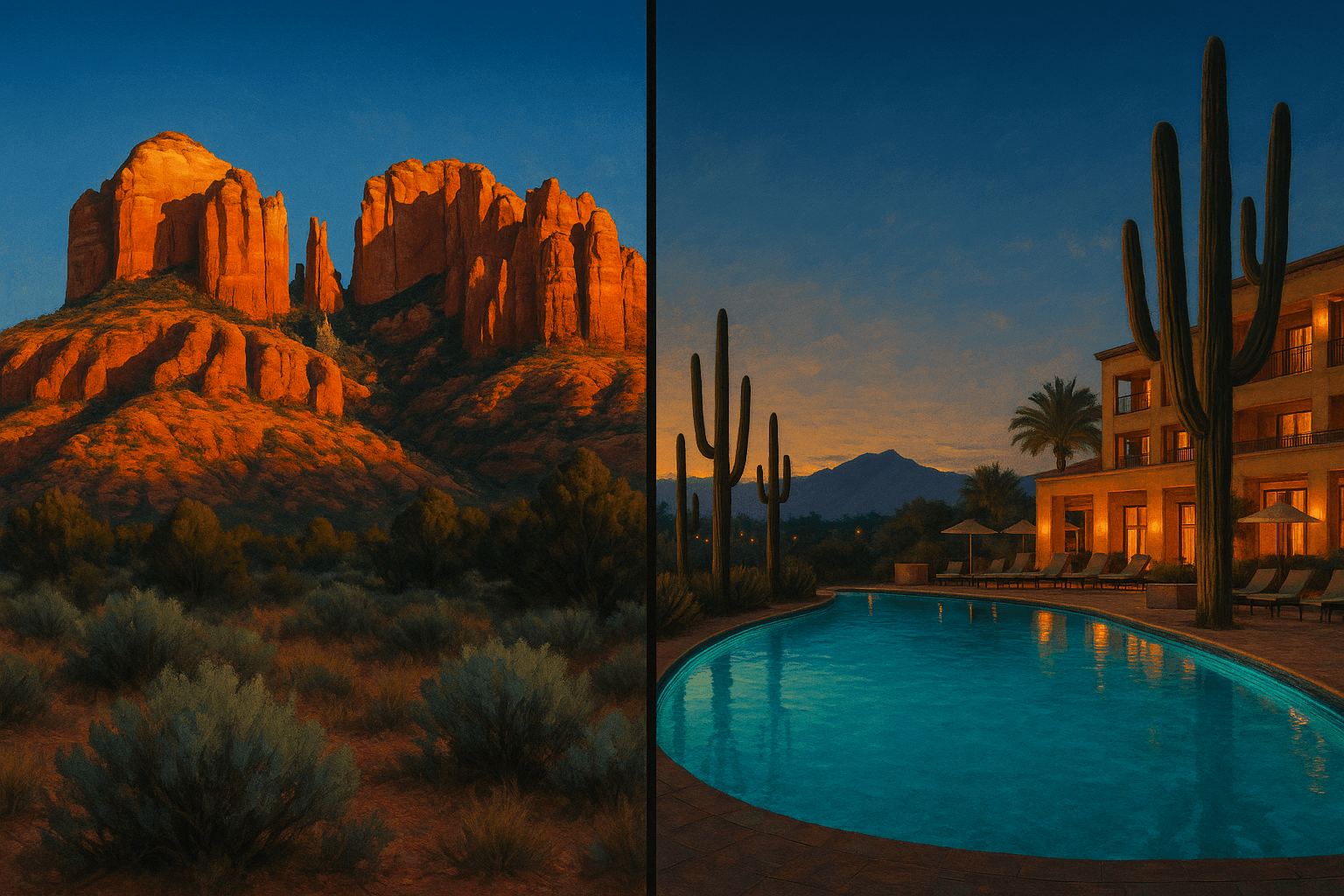

Sedona vs. Scottsdale: Which Arizona Escape Is Right for You?
Arizona has a way of making decisions difficult. Two of its most celebrated getaways — Sedona and Scottsdale — sit barely 120 miles apart, yet they cater to entirely different travel fantasies. Sedona calls to the hiker, the spiritually curious, the person who wants to stand in front of something so beautiful it feels unreal. Scottsdale calls to the golfer, the spa devotee, the diner who wants to split an exquisite bottle of wine while watching the desert turn purple at sunset.
So which one deserves your trip? This guide breaks down both destinations across every dimension that matters — landscape, activities, food, nightlife, budget, and timing — so you can book with confidence.
The Core Difference: Nature-First vs. Amenity-First
Sedona is about the land. Everything else — the restaurants, the resorts, the galleries — exists in service of the red rocks that surround the town. People come for the landscape and stay because it changes every hour with the light.
Scottsdale is about the experience. It's a polished, high-amenity destination built around comfort: world-class spas, championship golf, a thriving food and cocktail scene, and an arts district that punches above its weight. The desert is beautiful here too, but it's a backdrop rather than the main event.
Keep that distinction in mind as you read on — it'll make the decision much easier.
Landscape & Natural Setting
Sedona offers one of the most dramatic landscapes in North America. The town is ringed by towering red sandstone formations — Cathedral Rock, Bell Rock, Coffee Pot Rock, the grinning profile of Snoopy Rock visible from the highway — that glow orange, crimson, and deep violet depending on the time of day. Sitting at roughly 4,500 feet of elevation, Sedona enjoys meaningfully cooler temperatures than the valley below, and the terrain shifts between high desert, juniper-pinyon forest, and riparian creek corridors fed by Oak Creek.
Scottsdale occupies the Sonoran Desert floor at around 1,200 feet, northeast of Phoenix. The landscape is more classically "Arizona postcard" — expanses of creosote brush, towering saguaro cactus, and mountain ridges on the horizon. The McDowell Mountains rise to the east, and the McDowell Sonoran Preserve (36,000 acres — one of the largest urban nature preserves in the country) brings serious desert hiking right to the city's edge. Scottsdale's scenery is beautiful, but it functions as the setting for human activity — pools, patios, golf courses, rooftop bars — rather than being the destination itself.
Bottom line: For pure landscape, Sedona has no equal in the American Southwest. For a resort experience with gorgeous surroundings, Scottsdale delivers with polish.
Outdoor Adventures
Sedona
 Photo by John Bewlay on Unsplash
Sedona is one of the premier hiking destinations in the United States, with a trail network that ranges from accessible family strolls to demanding technical scrambles. The must-hike list:
- Devil's Bridge — The widest natural sandstone arch in the Sedona area. A 4.2-mile round trip ending on a narrow catwalk above the canyon with vertiginous views.
- Cathedral Rock — Short (1.2 miles round trip) but steep, requiring hands-on scrambling near the summit. The payoff is one of the most photographed panoramas in Arizona.
- Bell Rock Pathway — Accessible, relatively flat, and ideal for families or those who want iconic Sedona scenery without the effort.
- West Fork Trail — A 6.9-mile out-and-back through Oak Creek Canyon, threading between canyon walls and across wooden bridges. Particularly stunning in October when cottonwoods turn gold. In summer, Oak Creek itself offers swimming holes beloved by locals.
Beyond hiking, Sedona offers hot air ballooning at sunrise, purpose-built mountain biking singletrack, and the legendary Pink Jeep Tours — 4x4 off-road excursions that reach hidden canyon overlooks inaccessible on foot. The town also holds International Dark-Sky Community designation, making it one of the best stargazing spots in the Southwest on clear nights.
Scottsdale
Scottsdale's outdoor scene is anchored by two pillars: elite hiking and world-class golf. The McDowell Sonoran Preserve offers 240+ miles of trails — everything from flat desert loops to serious summit routes. Pinnacle Peak (3.5-mile round trip) is the visitor favorite, with big valley views and photogenic cactus scenery. Camelback Mountain's Echo Canyon Trail (on the Scottsdale-Phoenix border) is flat-out one of the best urban hikes in America: 2.4 miles round trip with 1,280 feet of gain — hard, exposed, and deeply rewarding.
For golf, Scottsdale operates at a different scale entirely. The Phoenix metro area has more than 200 courses, including landmark layouts like TPC Scottsdale (home of the PGA Tour's Phoenix Open), Troon North, and We-Ko-Pa. A round on a top course runs $150–$350 in peak season.
Other popular activities include tubing and kayaking on the Salt River, desert botanical garden visits (the Desert Botanical Garden's 140 acres of curated Sonoran flora is spectacular in spring wildflower season), and hot air ballooning.
Side-trip note: If the Grand Canyon is on your radar, Sedona makes a far better base — it's under 2 hours from the South Rim versus 3.5 hours from Scottsdale. Our full guide to hiking in the Grand Canyon covers everything you need before you go.
Spa & Wellness
Both cities are serious spa destinations — but the philosophies are very different.
Sedona's wellness culture is rooted in the landscape itself. The town is famous for its supposed energy vortexes — sites at Cathedral Rock, Bell Rock, Airport Mesa, and Boynton Canyon where visitors report a palpable sense of heightened energy or deep calm. Whether you believe in vortexes or not, the combination of red rock silence, clean desert air, and extraordinary scenery is genuinely restorative. The spa scene here is intimate and spiritually oriented: crystal healing, sound baths, reiki, and shamanic journey sessions sit alongside traditional massages and hydrotherapy. Top addresses include the Mii amo Spa at Enchantment Resort (one of the most consistently award-winning destination spas in the US) and the Spa at L'Auberge along the banks of Oak Creek.
Scottsdale built a grand, amenity-driven spa industry that now spans more than 50 destination spas. The flagship resort properties — the Four Seasons Scottsdale, the Phoenician, and Sanctuary Camelback Mountain — operate full-service facilities with multiple pools, fitness centers, multi-day wellness programs, and comprehensive treatment menus. Scottsdale's spas prioritize scale and luxury execution. It's the difference between a meditative forest retreat and a five-star urban wellness resort.
Verdict: For a luxury, European-style spa operation with every amenity, Scottsdale leads. For a nature-immersive wellness experience unlike anything else in the country, Sedona is incomparable.
Food & Dining
Scottsdale is the stronger food city — but Sedona has a handful of genuinely exceptional restaurants.
Sedona
Sedona's dining scene has improved substantially in recent years. The best restaurants lean into the setting — wide windows, canyon-view terraces, and menus rooted in Southwestern and New American cuisine. Top picks:
- Mariposa Latin Inspired Grill — Wood-fired meats and panoramic red rock views; a Sedona classic
- Elote Café — Creative, deeply flavored Mexican cuisine with a devoted following (book months ahead or plan to wait)
- The Vault — Elevated New American with one of Sedona's best wine lists
- L'Auberge Restaurant on the Creek — Romantic, creekside fine dining at the flagship resort
The honest caveat: Sedona's small size limits options, particularly at mid-range price points. Good dining here tends to be either excellent and pricey, or very casual.
Scottsdale
Scottsdale has one of the most vibrant restaurant scenes in the American Southwest. Old Town alone offers hundreds of options spanning every price point and cuisine style. Standouts include:
- FnB — A beloved locavore restaurant anchored in Arizona-grown ingredients
- Proof at the Four Seasons — Refined American cuisine in a striking desert setting
- Barrio Queen — Elevated Mexican in a lively atmosphere that earns fierce local loyalty
- Café Monarch — An intimate Old Scottsdale fine-dining institution
- Culinary Dropout — A great mid-market choice for groups, with a broad, satisfying menu
The range here is genuine: you can spend $12 on a superb breakfast burrito or $200 on a tasting menu, and both experiences hold up.
Nightlife, Arts & Culture
 Photo by Emily Irene Photo Co. on Unsplash
Scottsdale wins on nightlife; Sedona wins on authentic arts culture.
Scottsdale's Old Town is Arizona's most active nightlife district. The bar-and-club corridor along Scottsdale Road is famous for bachelorette parties and lively weekend crowds. But there's also cultural substance: the Marshall Way Arts District hosts galleries representing established and emerging Southwest artists, and the Scottsdale ArtWalk (Thursday evenings, year-round) is one of the longest-running gallery walks in the United States.
Sedona shuts down relatively early — most visitors are in bed by 10pm — but its cultural offering is sincere rather than performative. The town has a genuine gallery community, and Tlaquepaque Arts & Crafts Village is a genuinely beautiful marketplace where local artists sell original work from hand-tiled studio courtyards. The Sedona International Film Festival (each February) draws a respected program. If you want live music and late-night energy, Scottsdale is the clear choice. If you want quiet evenings and the feeling of being immersed in something real, Sedona delivers.
Where to Stay
Sedona
Sedona's accommodation landscape is split between high-end resorts and mid-range inns, with very little in the true budget tier.
- Enchantment Resort — Set in Boynton Canyon, adjacent to vortex sites, with casita-style rooms and the Mii amo spa. Rates from ~$650/night
- L'Auberge de Sedona — Romantic creekside cottages along Oak Creek, with outstanding dining and spa facilities. Rates from ~$500/night
- El Portal Sedona — An intimate, adobe-walled boutique hotel near Tlaquepaque. Rates from ~$250/night
- Sedona Rouge Hotel & Spa — A reliable mid-range option with pool and spa access. Rates from ~$200/night
Budget travelers often do better staying in Cottonwood (20 minutes south) and day-tripping into Sedona.
Scottsdale
Scottsdale has the broadest resort range in Arizona, from $100 roadside hotels to $1,000+ per night flagship properties.
- The Phoenician — A landmark Camelback Mountain resort with 8 restaurants, a 3-story spa, and multiple pools. Rates from ~$600/night
- Four Seasons at Troon North — Secluded casita-style luxury in north Scottsdale's desert hills. Rates from ~$700/night
- Hyatt Regency Scottsdale at Gainey Ranch — Strong family amenities with lagoon-style pools. Rates from ~$350/night
- Hotel Valley Ho — A lovingly restored mid-century modern hotel in Old Town with a legendary pool scene. Rates from ~$250/night
- Standard mid-range hotels and Airbnbs start around $100–$180/night across the broader Scottsdale area
Getting There & Getting Around
Both cities require a rental car — neither has meaningful public transit.
- Scottsdale: 25 minutes from Phoenix Sky Harbor International Airport (PHX), one of the most connected airports in the American Southwest. Flat, easy freeway access.
- Sedona: 2 hours from PHX via I-17 and Arizona Route 89A. The final stretch through Oak Creek Canyon is one of the most spectacular drives in the state — a winding descent through red canyon walls — but requires alert driving. Alternatively, fly into Flagstaff Pulliam Airport (FLG), 45 minutes from Sedona, though flight options are limited.
If you're building a broader Southwest itinerary — adding Flagstaff, Monument Valley, or Zion — Sedona slots more naturally into a northern Arizona loop. For planning an Arizona-anchored road trip, our guide to planning a US road trip has everything you need for flexible multi-stop itineraries.
Weather & Best Time to Visit
The best time to visit both cities is spring (March–May) or fall (September–November), when temperatures are comfortable and skies are reliably clear. Summer is the key differentiator:
| Sedona | Scottsdale | |
|---|---|---|
| Elevation | ~4,500 ft | ~1,200 ft |
| Summer highs (Jul–Aug) | 90–100°F | 105–115°F |
| Winter lows (Dec–Jan) | 30–40°F (snow possible) | 45–55°F |
| Peak season | Mar–May, Sep–Nov | Oct–Apr |
| Least recommended | July–August | June–August |
Scottsdale summers are genuinely extreme. Temperatures regularly top 110°F in July and August, making outdoor activity nearly impossible between 9am and 6pm. Summer does bring dramatic hotel discounts (40–50% off peak rates), which attracts deal-hunters willing to manage the heat.
Sedona summers are milder thanks to higher elevation — highs in the low 90s°F with afternoon monsoon storms that can make the red rocks steam dramatically. Still warm, but far more manageable for hiking (early morning starts essential).
Both cities shine in fall. If you're exploring US fall travel more broadly, our guide to the best US cities to visit in fall 2026 covers the full picture. For winter trips, Scottsdale is the stronger pick — mild temperatures and full resort programming. Sedona in winter can be magical (snow-dusted red rocks are stunning), but pack layers and check conditions. Both appear in our roundup of where to travel in the USA in December.
Budget: Which Is More Expensive?
Both destinations lean toward the premium end, but Scottsdale offers far more range at lower price floors.
| Sedona | Scottsdale | |
|---|---|---|
| Mid-range hotel/night | $250–$500 | $150–$400 |
| Dinner for two (mid-range) | $80–$150 | $60–$150 |
| Luxury dinner for two | $150–$250 | $120–$250 |
| Guided tour/activity | $100–$200 | $80–$350 (golf) |
| Trailhead parking | $3–$7/day (Red Rock Pass) | Free (most trailheads) |
| Budget hotel option | Limited | Many, from ~$100/night |
Sedona's small-town economy means there are fewer value options — mid-range accommodation is thin, and even casual restaurants carry resort-area pricing. Budget travelers can navigate it by packing trail snacks, booking ahead, and choosing independent inns over resorts.
Scottsdale's scale works in the budget traveler's favor: with hundreds of hotels and a restaurant scene spanning every price point, you can have an excellent Scottsdale trip for $150–$200/day per person if you're selective.
So, Which One Should You Choose?
Choose Sedona if you…
- Want to experience one of the most visually dramatic landscapes in the United States
- Are prioritizing hiking, photography, or outdoor adventure
- Are drawn to wellness, spirituality, or a quieter, restorative pace
- Are traveling as a couple looking for a romantic, nature-first escape
- Plan to add a Grand Canyon visit to your itinerary (under 2 hours from Sedona's South Rim)
Choose Scottsdale if you…
- Love golf, luxury pools, and the full resort experience
- Want diverse dining and an active nightlife scene
- Are traveling in a mixed group with different interests and need broad amenity options
- Prefer seamless airport access and an urban base
- Are visiting November through March and want reliable warmth
Can You Do Both?
Absolutely — and many visitors do. Scottsdale and Sedona are about 1 hour 45 minutes apart, and the drive up through Oak Creek Canyon is worth making for its own sake. A popular and well-balanced formula: 2–3 nights in Scottsdale (resort, spa, Old Town dining), then 2–3 nights in Sedona (hiking, vortexes, stargazing). Or base in Scottsdale and do Sedona as a full day trip — completely feasible if you leave by 7am.
Arizona also sits within easy reach of some of the country's most iconic landscapes. Several of the best national parks in the USA — the Grand Canyon, Petrified Forest, and Saguaro — are within 2–4 hours of either city, making either destination a natural launch pad for deeper Southwest exploration.
FAQ
Is it better to visit Sedona or Scottsdale? It depends on your priorities. Sedona is better for dramatic natural scenery, hiking, and spiritual or wellness experiences. Scottsdale is better for golf, luxury resorts, restaurant variety, and nightlife. For a romantic nature-immersive couple's trip, Sedona wins. For groups wanting maximum amenities and flexibility, Scottsdale wins. For the ideal trip, consider combining both — they're under two hours apart by car.
Why do people love Sedona so much? The landscape is the primary draw — the red rock formations are visually unlike anything else in the contiguous United States. Beyond scenery, Sedona has cultivated a reputation as an energy and wellness destination, with vortex sites, meditation retreats, and holistic healing arts that attract a devoted following. The combination of extraordinary natural beauty and a slower, quieter pace creates an experience that's difficult to replicate elsewhere.
How far apart are Scottsdale and Sedona? About 115–120 miles by road, roughly 1 hour 45 minutes to 2 hours depending on your route. The most scenic option is Route 89A through Oak Creek Canyon, which adds about 15 minutes but rewards the detour with stunning canyon views. The two cities are easily combined in a single Arizona itinerary.
Which is more expensive, Scottsdale or Sedona? Both lean premium, but Scottsdale offers far more flexibility across price points — from $100/night motels to $800/night resort suites. Sedona's smaller size means fewer budget options, and mid-range travelers often find it pricier on a per-night basis. At the luxury tier, flagship resorts in both cities run comparably ($500–$800+/night). Budget travelers have a substantially easier time in Scottsdale.
Envie de créer ta propre liste de spots ?
Rejoins Spotli.st et partage tes bonnes adresses avec le monde entier.
Créer mon compte gratuit